Is Summer Hair Loss Caused by Sun, Chlorine or Hormones?
If your hair looks or feels thinner after summer, there may be more than one reason.
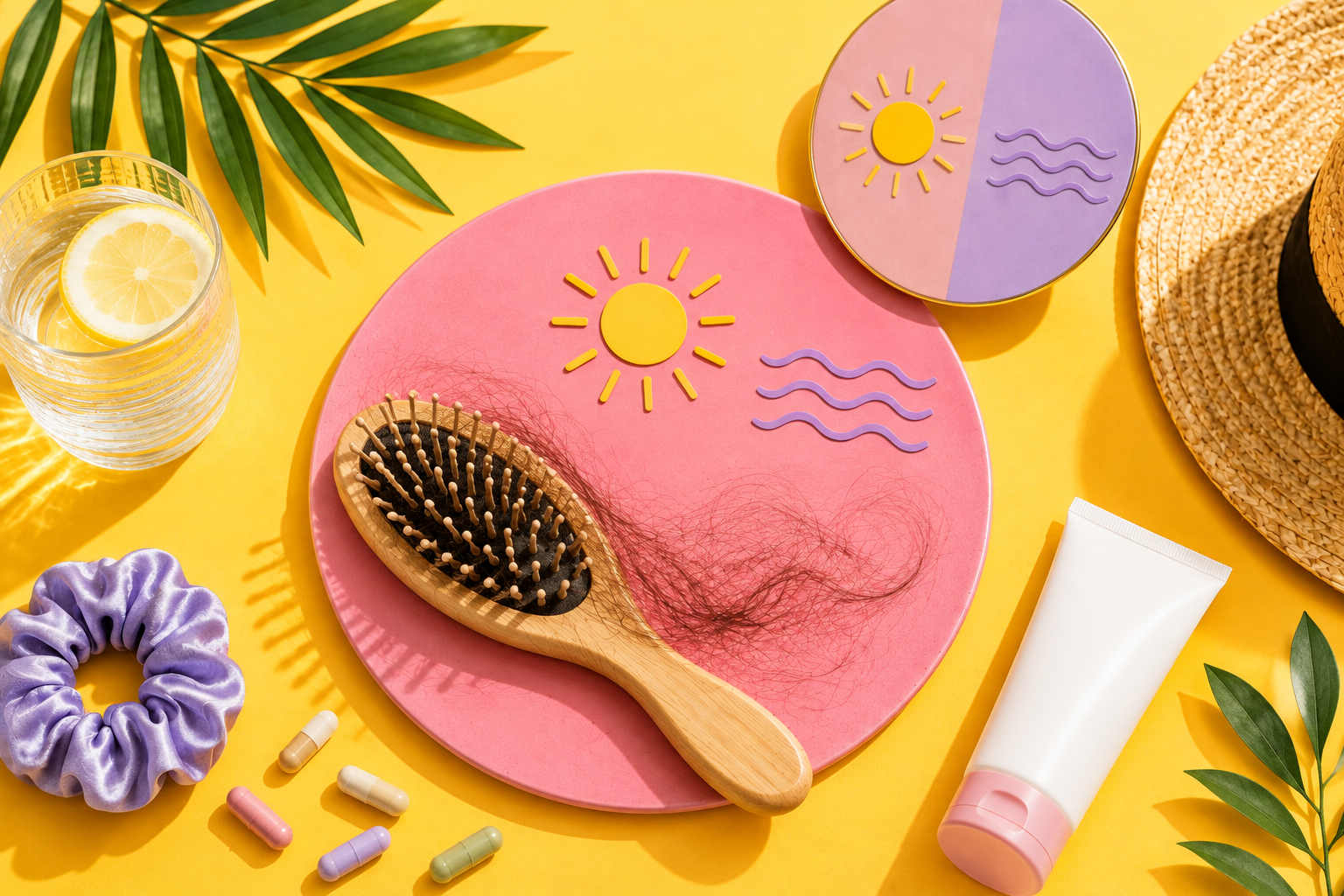
Sun, chlorine and salt water mainly affect the hair shaft rather than the follicle. Repeated UV exposure, swimming, washing and heat styling can leave hair drier, weaker and more prone to snapping. This breakage can reduce volume and make the hair appear thinner, but it is different from shedding, where the whole strand is released from the follicle.
Hormonal changes can also affect how hair grows and sheds, particularly during perimenopause and menopause. Some women notice increased shedding, finer hair, a less full ponytail or a gradually widening parting as hormone levels change.
However, hormones are not always the only explanation. Female pattern hair loss, stress, illness, nutritional deficiencies and genetic factors can occur at the same time. Summer damage may then make existing thinning appear more noticeable.
This is why it is useful to distinguish between breakage and true hair loss. If the main concern is dryness and breakage, gentler haircare and improving scalp condition may be appropriate. If shedding is persistent or density is reducing, it is worth investigating what may be happening at the follicle rather than assuming summer exposure is responsible.
How Do You Know What Is Causing Hair Thinning?
One of the most common mistakes with hair thinning is starting treatment before establishing what type of problem is actually present.
At The Lovely Clinic, we often meet patients who have already tried different shampoos, supplements or topical products but still do not know why their hair is changing. A detailed assessment can help distinguish between temporary shedding, progressive thinning, breakage and patterns that may require further investigation.
Your medical history matters too. Recent illness, medication, stress, changes in weight or diet, menstrual changes and symptoms associated with perimenopause or menopause can all provide useful context.
Where appropriate, further investigation may be considered. TrichoTest uses a simple cheek swab to analyse selected genetic variations that may be relevant to hair loss and treatment response. This information is considered alongside your clinical history and lifestyle rather than being treated as a simple “hair loss gene” result.
The results can also help inform bespoke prescription hair tonics and foams, allowing the ingredients to be selected according to the individual’s findings rather than taking a one-size-fits-all approach to topical treatment.
Mesotherapy may also be considered for suitable patients. This involves delivering selected ingredients directly into the scalp through a series of small injections. The exact approach depends on the individual and what is contributing to their hair loss.
For some patients, a consultation may also explore whether prescription-only options, including dutasteride mesotherapy, could be appropriate. As this requires medical assessment and is not suitable for everyone, the focus is on consultation and individual suitability rather than recommending a particular prescription treatment in advance.
If hair changes are occurring alongside symptoms that suggest wider hormonal changes, separate medical assessment may also be appropriate. The aim throughout is to understand the wider picture before deciding what, if anything, needs treating.
Can PRP Help With Hormonal Hair Loss?
When hormonal changes contribute to hair thinning, treatment needs to consider both the underlying factors and what is happening at the hair follicle. This can be particularly relevant during perimenopause and menopause, when some women notice their hair becoming finer or less dense.
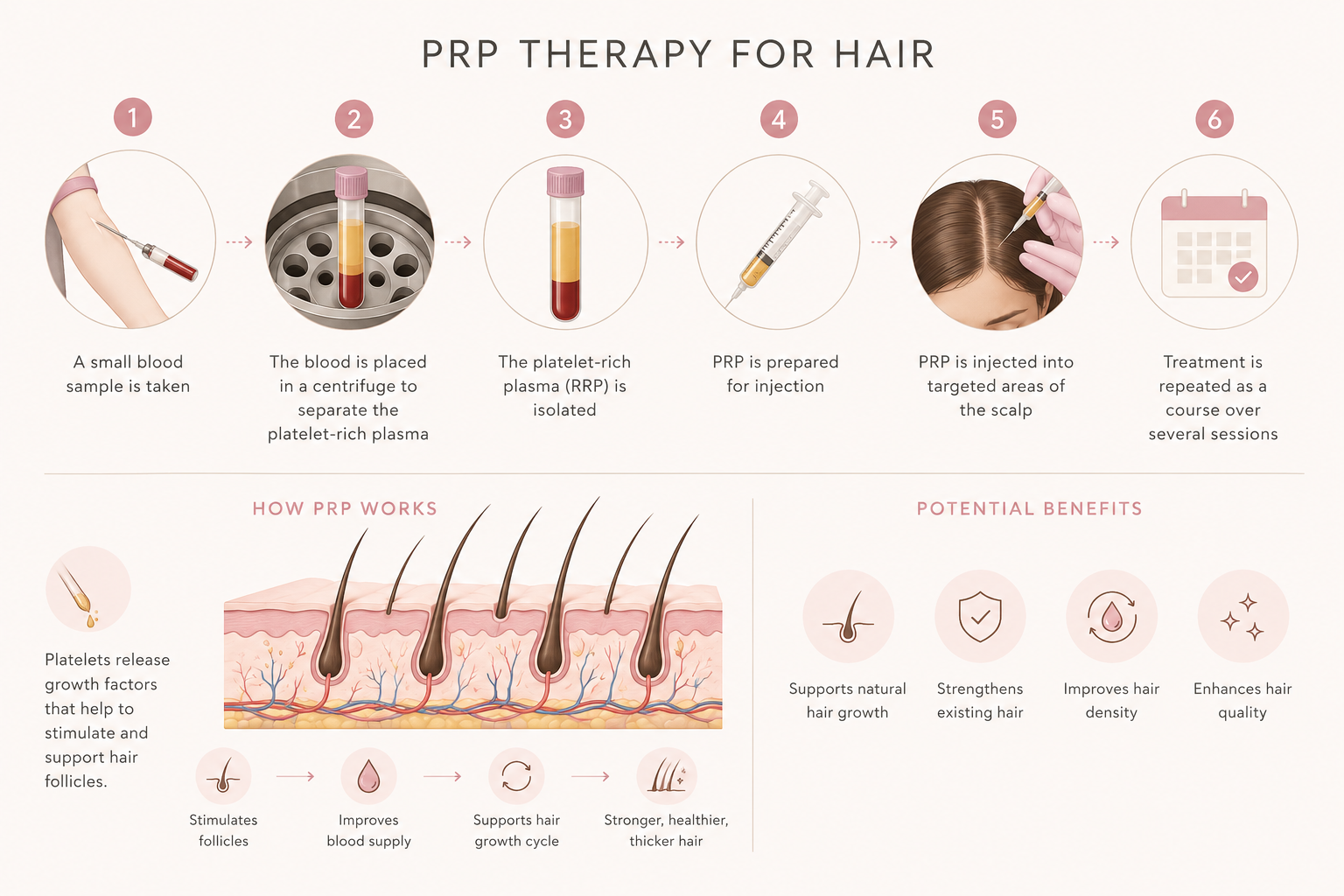
Where there is established thinning, Platelet Rich Plasma (PRP) Therapy for Hair may be considered to support the follicles themselves. PRP uses a small sample of your own blood, which is processed to concentrate the platelet-rich component before being injected into targeted areas of the scalp. The platelets release growth factors involved in cell signalling and tissue repair, with the aim of supporting the environment around existing hair follicles.
PRP does not correct the hormonal changes that may be contributing to hair loss. Instead, it may form one part of a wider approach when hormonal changes and follicular thinning occur together.
It is not suitable for every type of hair loss, and results vary between patients. Treatment is usually carried out as a course, with progress assessed over the following months as the hair moves through its natural growth cycle.
Can a Scalp Facial Help After Summer?
After a summer of sun exposure, swimming, increased sweating and more frequent washing, it is not only the hair itself that may feel different. The scalp can also become dry, oily, congested or affected by a build-up of products.
A Scalp Facial is designed to focus specifically on scalp health. The treatment uses hydrodermabrasion to cleanse and gently exfoliate the scalp, helping to remove excess oil, dead skin cells and build-up before targeted topical ingredients are applied.
For someone whose main concern after summer is scalp dryness, congestion or general scalp condition, this can be a useful supportive treatment. It may also be incorporated alongside a wider hair restoration plan when both scalp health and hair thinning need to be addressed.
It is important, however, to separate improving the scalp environment from treating the cause of hair loss. A Scalp Facial will not correct hormonal or genetic hair loss, so persistent shedding, a widening parting or progressive loss of density should still be properly assessed rather than treated as a scalp-care issue alone. Sudden or unexplained hair loss may also warrant assessment by your GP or another appropriate medical professional.
Frequently Asked Questions
Is it normal to lose hair every day?
Yes. Shedding is a normal part of the hair growth cycle, and the amount varies between people. Rather than becoming focused on a specific daily number, pay attention to a sustained change from your usual shedding pattern or visible changes in density.
Can damaged hair repair itself?
The visible hair shaft is not living tissue, so structural damage cannot biologically heal in the way skin can. Conditioning products and careful haircare can improve its appearance and manageability, while reducing further UV, chemical and heat damage can help protect the hair that remains.
Should I take supplements if my hair is thinning?
Not automatically. Supplements are most useful when there is an identified deficiency or specific nutritional reason for taking them. Taking multiple hair supplements without understanding the cause of thinning may be unnecessary and, in some cases, excessive intake of certain nutrients can itself be problematic.
Does wearing a hat protect thinning hair from the sun?
Yes, a hat can provide useful physical protection for both the hair and scalp. This becomes particularly important when hair density has reduced because more of the scalp may be exposed directly to UV radiation.
How long does it take to know whether a hair treatment is working?
Hair growth is slow, so assessment generally takes place over months. Consistent photographs taken under similar lighting and clinical reassessment are usually more informative than checking your hair from day to day.
Understanding What Your Hair Is Telling You
Not every increase in shedding after summer is a sign of hair loss, and not every change in hair density can be explained by hormones. What matters is recognising when something has changed and understanding whether the problem is breakage, temporary shedding or progressive thinning.
If the change persists, becomes more noticeable or is accompanied by other symptoms, a proper assessment can help establish whether further investigation or treatment is appropriate.
At The Lovely Clinic in Knightsbridge, Hair Restoration can be considered alongside wider health factors where relevant. If you are concerned about persistent shedding or changes in hair density, you can book a consultation for an individual assessment and advice on the most appropriate next steps.