

September has a way of making people take stock. The holidays are over, diaries are filling back up, and for many patients, this is also when they start noticing changes around the lower face – not dramatically, just enough to catch their eye in a photo or a bathroom mirror.
Maybe the jawline doesn’t look quite as sharp as it used to. Early jowling might be forming at the corners of the mouth, or the skin under the chin and along the neck may feel softer than it did a year or two ago. Summer tends to make these changes more obvious — months of sun exposure and dehydrated skin have a way of doing that.
Not every loss of jawline definition comes from the same cause, though. Skin laxity, shifting facial fat, and the slow decline in collagen that comes with age can all play a part in how the face meets the neck, often more than one at once.
A good non-surgical lifting plan starts by working out which of these is actually happening, rather than treating whatever looks loose.
At The Lovely Clinic in Knightsbridge, Sofwave® and Thread Lifting are two of the treatments we reach for, and they do quite different jobs.
Why Does the Jawline Become Less Defined with Age?
A defined jawline isn’t just about the shape of the bone underneath.
When we’re younger, firm skin and strong connective tissue hold everything in the lower face where it should be. As collagen and elastin production slows, skin becomes less resilient – and changes in facial fat and deeper supporting structures shift how tissue sits over the jaw.
What that tends to look like:
- Softening along what used to be a sharp jawline
- Early or more established jowling
- Looser skin under the chin
- Less distinction between the jaw and neck
- Creasing or laxity through the neck
Which is part of why adding volume isn’t always the fix. If the real issue is lax skin, more volume in the lower face can end up making it feel heavier rather than more defined. A more useful question is usually whether the tissue needs better collagen support, or whether it needs to be physically moved.
That distinction is more or less the difference between Sofwave and thread lifts.
What Does Sofwave Do for the Jawline and Neck?
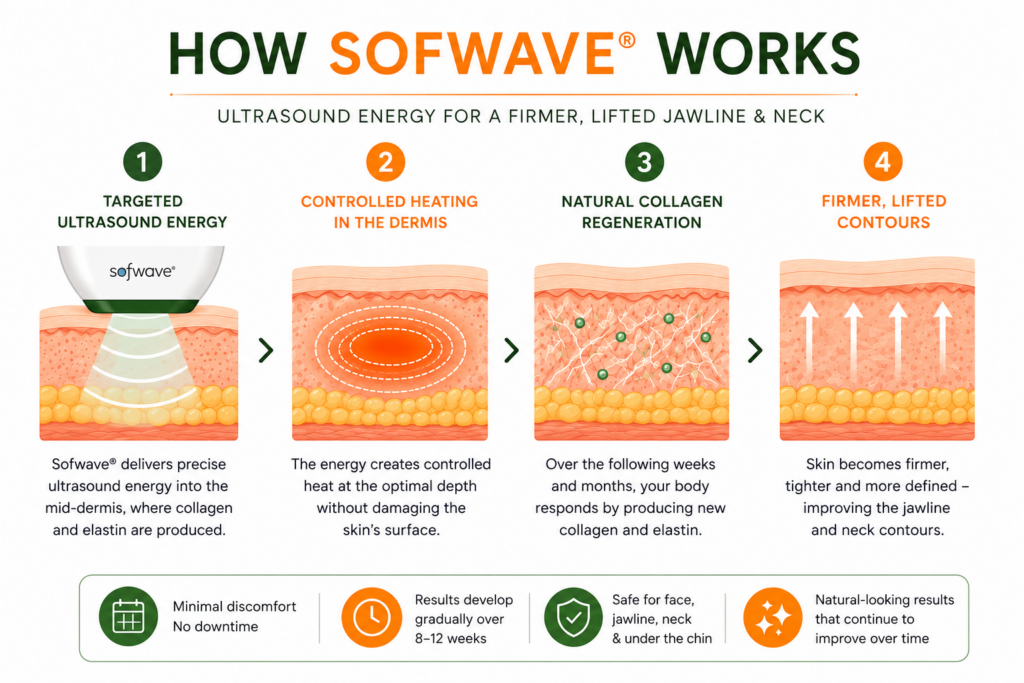
Sofwave® is an ultrasound treatment built to stimulate new collagen and elastin in the skin.
Its SUPERB™ technology sends controlled ultrasound energy into the mid-dermis, and the heat this generates triggers a healing response. A SofCool™ cooling system protects the skin’s surface while that happens underneath.
It doesn’t physically pull tissue upward – instead, it encourages the skin to rebuild some of its own structural support.
That makes it a good fit for mild to moderate skin laxity. Around the lower face and neck, the goal is to gradually firm things up, so the contours look tighter and the transition from jaw to neck reads more cleanly.
Don’t expect results overnight. New collagen takes time to form, so most patients see the lifting and tightening effect build gradually over roughly 8 to 12 weeks.
For anyone heading back into a busy autumn schedule, Sofwave also offers none to minimal downtime.
Who Is Sofwave Best Suited To?
For milder cases – where laxity is just starting and tissue hasn’t noticeably dropped – we’d usually look at improving the skin’s own support before considering anything more mechanical. Although we do have some great before-and-after pictures of older patients after Sofwave, they might just require more sessions.
Sofwave tends to make sense if you’ve started noticing:
- A softer jawline
- Laxity under the chin
- Looseness through the neck
- Reduced skin firmness
- Fine lines alongside laxity
It also suits people who’d rather deal with these changes gradually, instead of waiting for laxity to become more obvious.
There’s a limit to what it can do, though. Collagen stimulation can’t remove a meaningful amount of excess skin or achieve the kind of repositioning surgery can.
How Do Thread Lifts Improve Jawline Definition?
A thread lift takes a different approach.
Fine, dissolvable threads go in beneath the skin, where they support and reposition tissue. Some are designed specifically for suspension, letting an experienced practitioner lift tissue that’s already started to drop.
That mechanical element matters most in the lower face. If skin and tissue have genuinely moved downward, stimulating collagen alone might improve firmness without changing their position much. A thread lift can lift more directly – smoothing jowls and sharpening the jawline in a way collagen stimulation on its own can’t.
Threads stimulate collagen too, as the surrounding tissue responds to their presence, so it isn’t a purely mechanical treatment.
At The Lovely Clinic, we choose thread type and length based on the area and how much support it needs -APTOS® and Silhouette Soft® threads are all options, rather than one technique applied to every face.
When Is a Thread Lift Better Than Sofwave?
Neither treatment is simply “better.” It comes down to what’s actually causing the loss of definition.
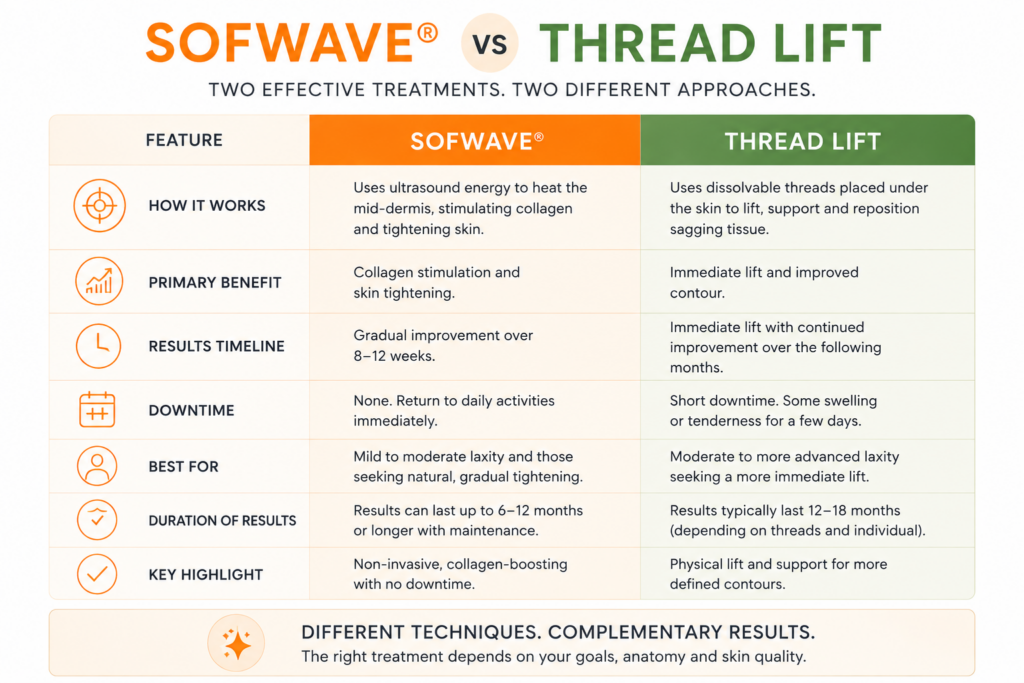
Broadly: Sofwave improves the skin’s own support, and thread lifts physically move tissue. If your facial tissue is still reasonably firm but the skin has started to lose laxity, Sofwave alone may do enough. If there’s more visible jowling or tissue descent, we’d usually want to look at whether suspension threads are needed to get the lift you’re after.
Skin thickness plays a role too, along with how facial fat is distributed, any previous aesthetic treatments, asymmetry and general skin quality. That’s why two people the same age with what looks like the same “sagging jawline” can walk away with completely different recommendations.
Can You Combine Sofwave and Thread Lifts?
Sofwave and thread lifting deal with related problems in different ways – one gets the skin producing more of its own structural proteins, the other provides physical support and repositioning.
For some patients, a staged combination addresses more than one part of lower-face ageing at once. Take moderate jowling alongside generally declining skin firmness: threads might reposition dropped tissue, while Sofwave works on firmness and collagen support as part of a wider plan.
We regularly see patients who’ve decided they need a specific procedure because they saw it work for someone with a similar concern. Once we actually assess the face in person, the underlying issue is often quite different.
Will a Non-Surgical Neck Lift Get Rid of Loose Neck Skin?
“Non-surgical neck lift” is a search term that can set expectations too high. Sofwave can improve firmness across the neck, and suspension threads can lift a sagging neck in the right patients, but neither one removes excess skin surgically. So how much laxity you actually have matters a great deal.
Early crepiness and reduced elasticity respond well to collagen stimulation. More obvious tissue descent usually needs more mechanical support. And a significant amount of excess skin may simply be beyond what any non-surgical treatment can reasonably fix.
A consultation worth having addresses that honestly, rather than trying to make every patient fit the treatment on offer.
How Do I Know Which Jawline Treatment I Need?
Rather than starting with a treatment name, it helps to look at what’s actually changed. Has the skin itself loosened, or has tissue dropped from the mid or lower face? Is the neck the main issue, or is it more about how the chin, jawline and neck relate to each other?
An assessment should also factor in skin quality and thickness, facial proportions, any previous treatments, and how much change you’re hoping for.
Sometimes Sofwave is the right call. Sometimes it’s the mechanical support a thread lift provides. For other patients, a carefully staged combination makes more sense.
The goal isn’t just a tighter face – it’s keeping your proportions intact while restoring enough support that the jaw and neck look naturally better defined.
FAQs About Sofwave, Thread Lifts and Jawline Definition
Can I have a thread lift if I have previously had dermal filler?
Probably, but your practitioner needs to know what was used, where it was placed, and roughly when, before planning a thread treatment.
Can Sofwave be used if I do not want injectables?
Yes. It relies on ultrasound energy rather than anything injected, which makes it an option if you want more skin firmness without adding volume.
Will losing weight affect the results of a jawline or neck treatment?
It can. A significant weight change can shift facial fat distribution and skin laxity, so if you’re actively losing a lot of weight, it’s often worth waiting until things settle before treating.
Can men have Sofwave or thread lifts for the jawline?
Yes – the principles are the same, though planning needs to account for differences in facial structure, skin thickness and hair distribution.
Is there an age when I should start treating jawline laxity?
Not really. It comes down to what’s happening anatomically, not your age on paper. Some people notice laxity earlier than others; some hold onto strong skin support for much longer.
Considering a Jawline or Neck Lift in London This Autumn?
If your jawline or neck has started to shift, it’s best to find out why before choosing a treatment.
At The Lovely Clinic in Knightsbridge, London, a consultation means having your lower face and neck properly assessed—skin quality, tissue position, and how much laxity is actually there. From there, we can talk through whether Sofwave, thread lifting, or a considered combination fits the result you have in mind.
If autumn feels like the right time to deal with something you’ve been noticing for a while, book a consultation to talk through your options and build a plan around your face, your schedule and the changes you actually want to make.