

Summer has a habit of drawing our attention to things we barely notice during the rest of the year. After several months of wearing shorts, dresses and swimwear, small red, blue or purple veins across the legs can suddenly seem much more visible.
These are commonly known as spider veins or thread veins. They are usually harmless, but for some people they become an aesthetic concern, particularly when clusters develop around the thighs, calves or knees.
At The Lovely Clinic in Knightsbridge, late summer is a common time for patients to start asking about treating visible leg veins. August can be a particularly practical time to begin sclerotherapy, not because the treatment suddenly becomes more effective at the end of summer, but because the treatment and recovery process fit naturally with the change of season.
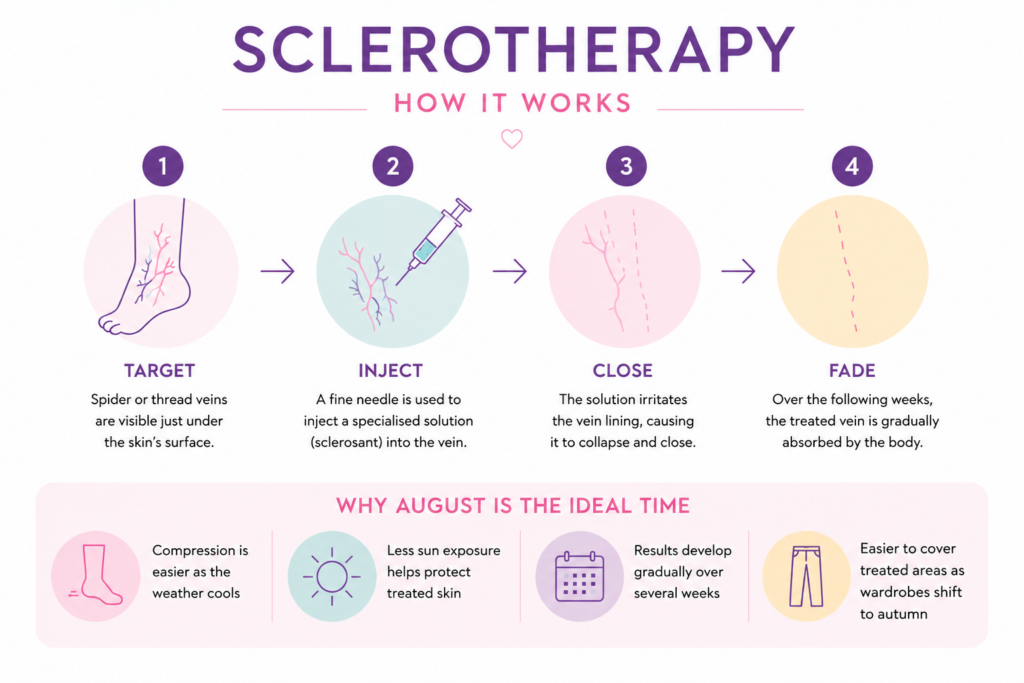
Compression garments may be recommended following treatment, treated areas need appropriate protection from sun exposure, and results develop gradually rather than overnight. Starting as summer draws to a close therefore gives the skin time to settle while legs are increasingly covered by trousers, tights and longer clothing.
What is sclerotherapy and how does it treat spider veins?
Sclerotherapy is an injectable treatment for unwanted superficial veins, particularly spider and thread veins on the legs.
A specialised solution, known as a sclerosant, is carefully injected into the targeted vessel. This irritates the inner lining of the vein and causes it to close. Blood is naturally redirected through other healthy vessels, while the treated vein is gradually broken down and absorbed by the body.
This is why sclerotherapy should not be thought of as simply making a vein disappear during the appointment. Although a vessel may initially look different immediately after injection, the visible improvement develops as the body processes the treated vein over the following weeks.
At The Lovely Clinic, a sclerotherapy appointment typically takes around 30 to 45 minutes. Several areas can potentially be addressed during one session, depending on the number, distribution and size of the veins being treated.
Some patients only have a small isolated patch. Others have networks of vessels across both legs. The treatment plan should reflect what is actually present rather than applying the same number of sessions to everyone.
Why is late August a good time for sclerotherapy?
There is no single month in which sclerotherapy has to be performed. However, from a practical perspective, late summer and autumn can make the aftercare considerably easier to accommodate.
Compression is easier when the weather cools
Following sclerotherapy, your practitioner may recommend compression stockings for a short period. Compression supports the treated area during the early recovery period.
Anyone who has worn compression hosiery during a heatwave will understand why this can be less appealing in June or July. By late August, wardrobes are beginning to change and wearing trousers, tights or compression garments generally becomes easier.
You are less likely to be exposing your legs to strong sun
Sun protection matters following many procedures that temporarily leave the skin inflamed or vulnerable to pigmentation changes.
Sclerotherapy can cause temporary bruising, redness or pigmentation around treated vessels. Keeping recovering areas protected from strong UV exposure is therefore sensible, particularly while visible post-treatment changes are settling.
If you have just returned from your final summer holiday and do not have another week of sunbathing planned, the timing can be much easier to manage.
Results have time to develop
One of the most important things we explain to patients is that sclerotherapy is not an instant-results treatment.
The Lovely Clinic advises that it normally takes around four weeks to appreciate the full effect of an individual treatment session. Some patients require a course of treatment, with the clinic noting that approximately three to five sessions spaced around a month apart may be appropriate in some cases.
Beginning towards the end of August therefore gives you several months in which treatment can be assessed, repeated where appropriate and allowed to settle before legs are routinely uncovered again.
Who is a good candidate for sclerotherapy?
Sclerotherapy can be particularly useful for visible blue, purple or red vessels on the legs, but not every visible vein should automatically be injected.
The appearance of the vessels matters. So does their location, size and whether there are symptoms suggesting a more significant venous problem.
At The Lovely Clinic, we often see patients who describe everything visible on the leg as a “broken capillary”, when examination shows several different types and depths of vessels.
This distinction matters because different vessels respond better to different treatment approaches.
For relatively straightforward superficial leg veins, sclerotherapy may be appropriate. However, someone with prominent varicose veins accompanied by aching, swelling, heaviness, itching, skin changes, or a history suggesting venous insufficiency requires appropriate clinical assessment rather than assuming the problem is purely cosmetic.
NICE recommends specialist vascular assessment and duplex ultrasound for people with symptomatic primary or recurrent varicose veins and certain complications of venous disease.
Pregnancy is also an important consideration. Interventional treatment of varicose veins is not routinely recommended during pregnancy.
Can sclerotherapy treat veins around the ankles and feet?
This is an area where careful treatment selection becomes particularly important.
At The Lovely Clinic, we do not perform sclerotherapy around the ankle or foot because of the vascular anatomy and the associated risk of skin breakdown.
That does not necessarily mean visible vessels in these areas cannot be treated. It means a different technology may be more appropriate.
For smaller vessels around the ankles, for example, ClearV laser treatment may be considered instead. ClearV is designed to target vascular concerns while minimising damage to the surrounding tissue.
This is a good example of why a consultation is more useful than deciding in advance that you simply “need sclerotherapy”. The objective is to choose the safest and most appropriate treatment for the vessel in front of us.
Is August too late to start treating spider veins?
Not at all. In many ways, it is when the treatment calendar begins to make more sense.
Starting in late August gives you the cooler months ahead for treatment, recovery and reassessment. As several sessions are appropriate, these can be spaced rather than rushed to meet an imminent holiday or event.
The important point is to plan backwards from when you want your legs exposed, rather than waiting until immediately before that date to begin treatment.
At The Lovely Clinic in Knightsbridge, the first step is an assessment of the veins themselves. From there, your practitioner can determine whether sclerotherapy is appropriate for you.
Frequently Asked Questions About Sclerotherapy
Can spider veins come back after sclerotherapy?
A successfully treated vessel can be closed and gradually absorbed, but sclerotherapy does not remove an underlying tendency to develop spider veins. New vessels can therefore appear elsewhere in the future.
Does sclerotherapy hurt?
Very fine needles are used, and most patients tolerate the procedure well, although you may feel brief stinging or discomfort as individual vessels are injected.
Can I exercise after sclerotherapy?
Walking is generally encouraged after treatment, but your practitioner may ask you to temporarily modify more strenuous exercise. Follow the aftercare instructions provided for your individual treatment rather than assuming your usual routine can be resumed immediately.
What are the risks of sclerotherapy?
Potential effects include bruising, tenderness, temporary pigmentation and small areas of trapped blood within treated vessels. More significant complications are uncommon but possible, which is why appropriate patient selection, treatment technique and informed consent are important.
Can I have sclerotherapy before going on holiday?
It is usually more practical to schedule treatment after a sunny holiday rather than immediately beforehand. You need to account for compression, UV protection and the fact that bruising or pigmentation may remain visible while the area settles.
Thinking About Treating Your Leg Veins This Autumn?
If summer has made you more aware of visible spider or thread veins, late August is a sensible point to have them properly assessed rather than rushing into treatment just before your next occasion.
At The Lovely Clinic in Knightsbridge, London, we can assess the type, size and location of the vessels and advise whether sclerotherapy or another available vascular treatment is appropriate.
Book a consultation to discuss your leg veins and create a treatment plan that can be carried out gradually through the cooler months.