Microspicules are attracting attention, largely through the growing influence of Korean skincare. But behind the trend is an interesting question about how topical skincare interacts with the skin.
Our skin is designed to be difficult to penetrate. The outermost layer, known as the stratum corneum, forms an important protective barrier that helps prevent water loss and limits what can enter from the outside. This is essential for healthy skin, but it also presents a challenge: applying an active ingredient does not necessarily mean that the ingredient can travel easily through the skin barrier.
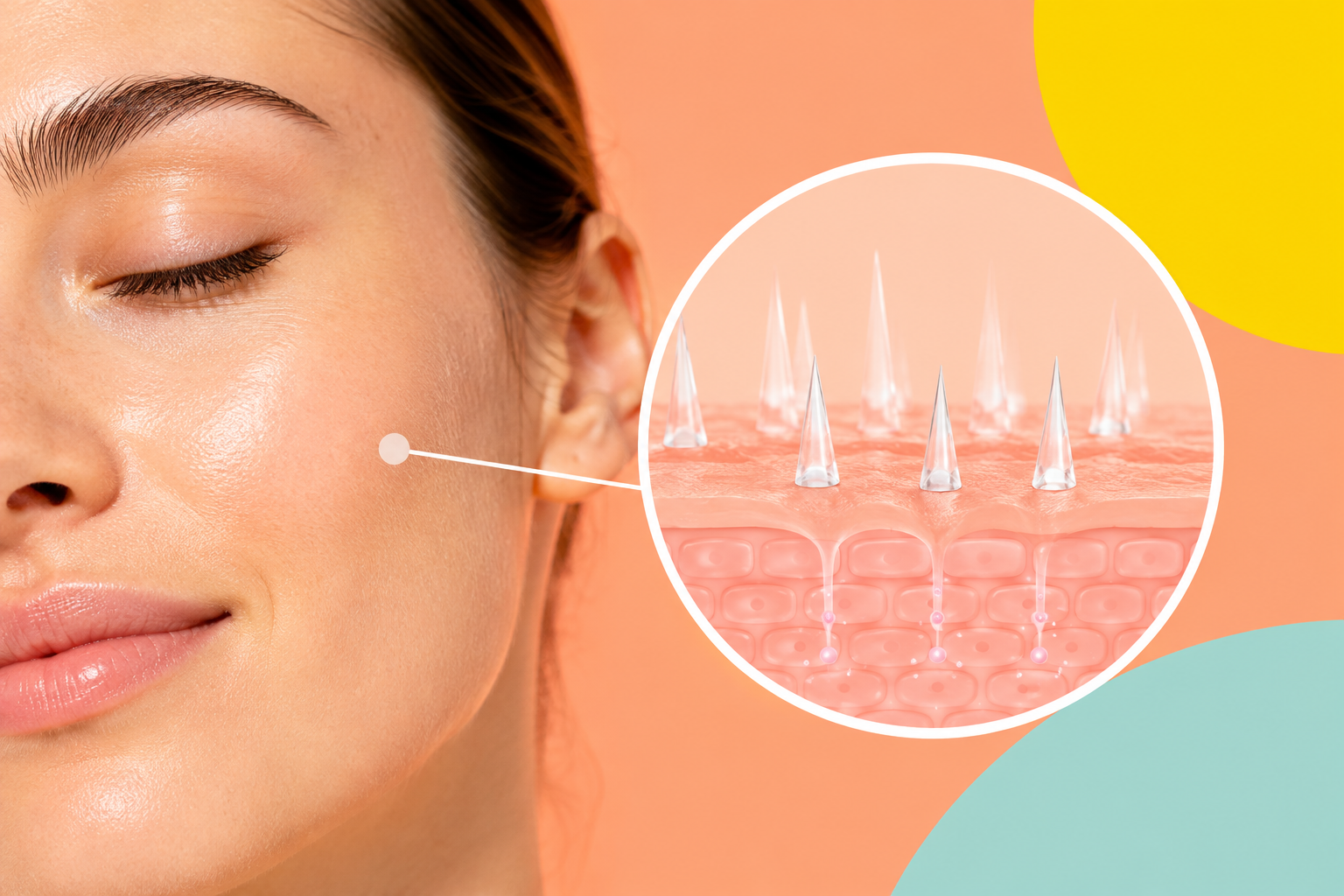
This is where microspicules become interesting. Microspicules are microscopic, needle-shaped structures, commonly derived from certain types of sponge. When applied to the skin, they interact with its superficial layers and create temporary microscopic pathways. This has led to growing interest in their potential to support the delivery of selected skincare ingredients while also providing a controlled physical stimulus that encourages skin renewal.
They are sometimes referred to online as “liquid microneedling”, although this can be misleading. Microspicules and conventional microneedling work differently and, importantly, at different depths within the skin.
At The Lovely Clinic in Knightsbridge, microspicules are used within the Cell Renewal Facial, giving us a useful clinical perspective on where this technology may fit within a wider approach to skin health.
In this guide, we look at what microspicules are, how they work, what they may help improve and how they compare with established treatments such as microneedling and chemical peels.
What Are Microspicules and What Do They Do to Your Skin?
Microspicules are tiny, needle-shaped structures, derived from freshwater or marine sponges. They are mainly made from silica and are microscopic, so they are very different from the needles used during treatments such as microneedling.
Once applied, their role goes beyond simply sitting on the skin’s surface. Their fine structure provides a gentle physical stimulus, encouraging the natural processes involved in skin renewal. This is why microspicule treatments are being explored for concerns such as dullness, rough texture, visible pores and early signs of skin ageing.
Another important part of the technology is what accompanies the microspicules. Different systems use different formulations, and the ingredients delivered alongside them can influence what the treatment is designed to achieve.
At The Lovely Clinic, for example, the Cell Renewal Facial uses Cellstory’s Microspear® technology. It combines approximately 50,000 purified microspicules with ingredients including growth factors, amino acids, plant stem cells and botanical extracts.
This combination is designed to support the skin as it renews rather than relying on the microspicules alone. This distinction matters because, when comparing microspicule treatments, formulation, quality, and delivery systems matter as much as the presence of microspicules.
How Do Microspicules Work in Skincare?
To understand why microspicules have attracted so much attention, it helps to understand why skincare absorption is difficult in the first place. Your skin is not a sponge. A serum disappearing from the surface does not necessarily mean all of its ingredients have travelled deeply into the skin. The stratum corneum is deliberately resistant to penetration, and factors such as molecular size and formulation influence how far an ingredient can travel.
Microspicules provide a different route. Their microscopic structure creates temporary channels in the upper layers of the skin. This can increase permeability and potentially improve the delivery of selected active ingredients.
That does not mean microspicules push everything deep into the face. The effect depends on the particular spicule technology, the formulation being used and the characteristics of the ingredient itself.
The physical interaction also explains the characteristic prickling sensation people often report. Unlike conventional microneedling, there is no motorised device repeatedly inserting needles to a predetermined depth. The microscopic spicules themselves remain temporarily within the superficial skin before being naturally shed as the skin renews.
With the Cellstory technology, patients may notice gentle prickling for up to approximately 72 hours. The skin may also appear temporarily flushed. This does not mean the treatment needs to feel intensely uncomfortable to be effective. In skin treatment, stronger sensation and more inflammation are not automatically signs of a better result. What matters is creating the appropriate degree of stimulation for the skin in front of us.
What Are the Benefits of Microspicules for Your Skin?
Microspicules are best understood as a skin-quality treatment. Rather than changing facial shape or targeting one deep structural problem, their appeal lies in improving how the skin looks and feels more generally.
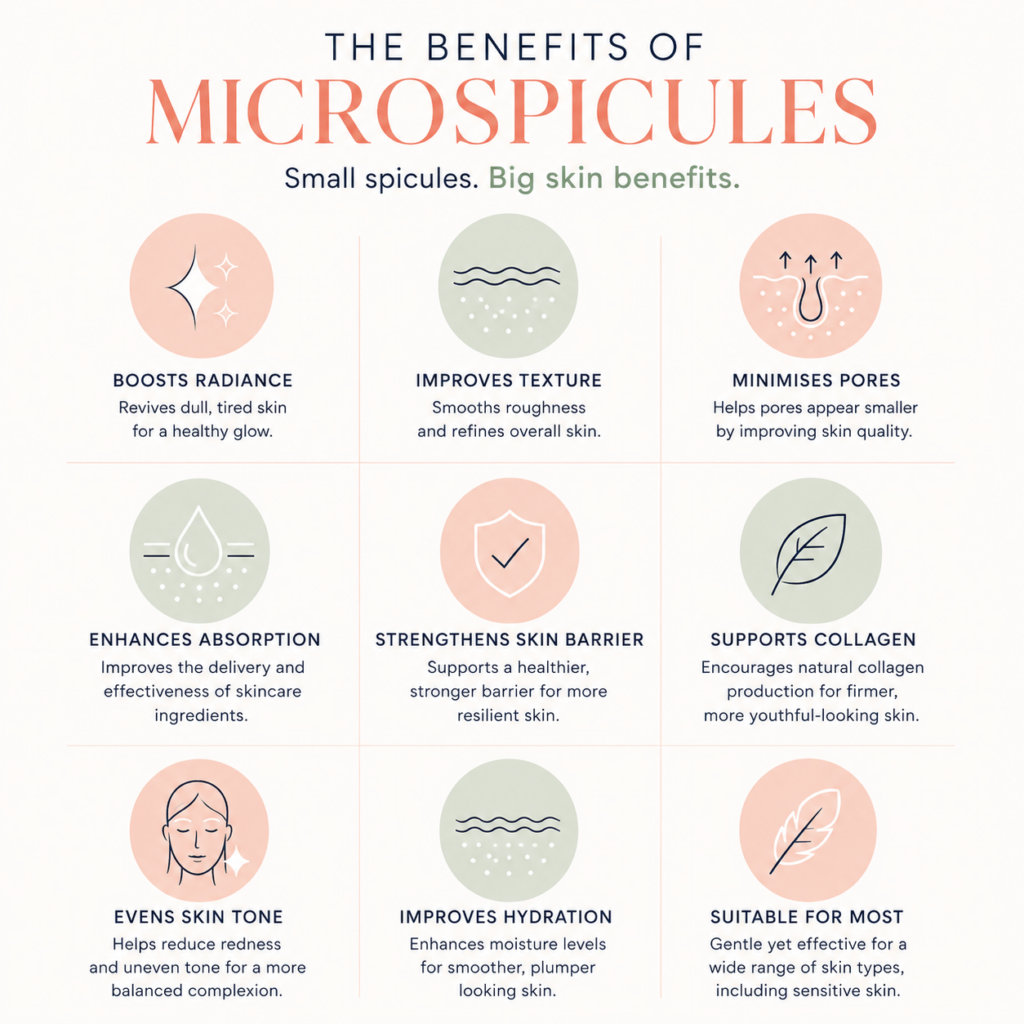
Microspicules have become fashionable, but skin biology has not changed. We still need to match the treatment depth to the problem.
Can Microspicules Help with Pores, Texture and Acne Scars?
Microspicules can help with mild uneven texture, congestion, and visible pores. While pores cannot physically open, close or permanently shrink, improving surface texture and skin quality can make them appear less noticeable.
With acne, the depth of the concern matters. Flat post-acne marks and superficial texture differ from indented scars caused by changes deeper within the skin. Microspicules may support more superficial concerns, but established acne scarring usually requires deeper collagen remodelling.
At The Lovely Clinic, treatments such as SkinPen® Precision Microneedling or INTRAcel®, which combines microneedling with radiofrequency, may be considered when more significant textural change is needed.
Microspicules vs Microneedling: What Is the Difference?
Although microspicules are sometimes described as “liquid microneedling”, the treatments work differently.
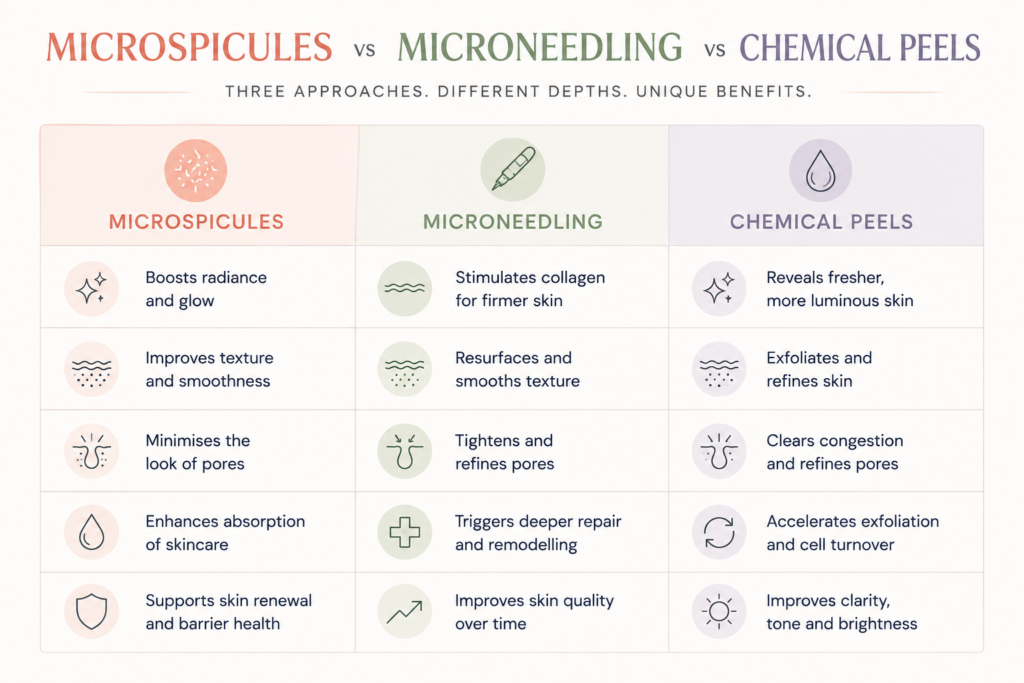
Microspicules act primarily within the superficial layers of the skin, creating temporary microscopic pathways and supporting skin renewal. Microneedling uses physical needles at controlled depths to trigger a stronger healing and collagen-remodelling response.
For dullness, visible pores and mild textural changes, microspicules may be enough. For established acne scars or concerns requiring deeper remodelling, microneedling may be more appropriate. The decision should therefore be based on the depth and severity of the concern, rather than which treatment is trending.
Microspicules vs Chemical Peels: Which Is Better?
Both treatments can improve skin texture, but through different mechanisms.
Chemical Peels use carefully selected acids to exfoliate the skin, making them particularly useful where congestion, surface build-up or certain pigmentation concerns are present. Microspicules use microscopic physical structures to support renewal and the delivery of selected active ingredients.
Neither is inherently better. For some patients, a peel is the more appropriate choice; for others, microspicules make more sense. They may also be used at different stages of a longer-term skin plan, depending on how the skin changes and responds.
Are Microspicules Worth It or Just Another Skincare Trend?
There is certainly a trend surrounding microspicules, particularly because of the enormous international interest in Korean skincare. But the underlying concept is more interesting than the hype.
Microspicules represent a wider shift in skincare towards thinking not only about which ingredients we apply, but also how those ingredients interact with and move through the skin barrier. That makes them a genuinely interesting addition to modern skin treatment.
What they do not do is make every established technology redundant. A superficial skin-quality concern does not necessarily need a laser. Equally, an established acne scar is unlikely to disappear because we have found a cleverer way to deliver topical skincare.
At The Lovely Clinic, we often find that the most useful part of a skin consultation is identifying where the problem actually sits. What looks like “bad texture” to a patient might be congestion, dehydration, pigmentation, enlarged pores, acne scarring or early loss of elasticity. Often, it is a combination.
Microspicules earn their place when their mechanism matches the problem we are trying to solve. That is a much more useful way to think about them than asking whether they are the next miracle ingredient.
Frequently Asked Questions About Microspicules
How long do microspicules stay in your skin?
This varies according to the technology used. With the Cellstory system used at TLC, a gentle prickling sensation can remain for up to approximately 72 hours while the microspicules naturally shed and the skin renews.
Can you wear makeup after microspicules?
This depends on the treatment and how your skin responds. Even with minimal visible downtime, you may be advised to give freshly treated skin a short break from unnecessary products. Follow the aftercare advice given for your specific treatment.
Should you stop retinol before using microspicules?
Strong retinoids and exfoliating acids can increase skin sensitivity, so review your current routine before professional treatment. Do not stop prescription skincare without appropriate medical advice.
Do microspicules cause peeling?
Not everyone will visibly peel. Mild dryness, flushing or changes in surface texture can occur as the skin renews, depending on the particular microspicule treatment and individual skin response.
Can microspicules be used on sensitive skin?
Some microspicule treatments are designed for sensitive skin, including the Cell Renewal Facial offered at TLC. However, “sensitive skin” can mean many different things. Active inflammation, rosacea, dermatitis or an impaired skin barrier should be considered individually before treatment.
How often can you have microspicule treatments?
Frequency depends on the system and the condition being treated. For the Cell Renewal Facial, TLC recommends an initial course of four weekly treatments followed by monthly maintenance where appropriate.
Considering Microspicules in London?
Microspicules are a fascinating development in skincare, particularly for patients interested in improving texture, radiance and overall skin quality without immediately moving towards a more intensive procedure.
The important part is deciding whether that level of treatment matches what is happening within your skin.
At The Lovely Clinic in Knightsbridge, London, the Cell Renewal Facial is the clinic’s microspicule-based treatment, using Cellstory Microspear® technology. A consultation can also help determine whether microspicules make sense for your concerns or whether an alternative approach such as a Chemical Peel, Microneedling or INTRAcel® would be more appropriate.
If you are considering microspicules in Knightsbridge or central London, you can book a consultation to have your skin assessed and build a treatment plan around what it genuinely needs.